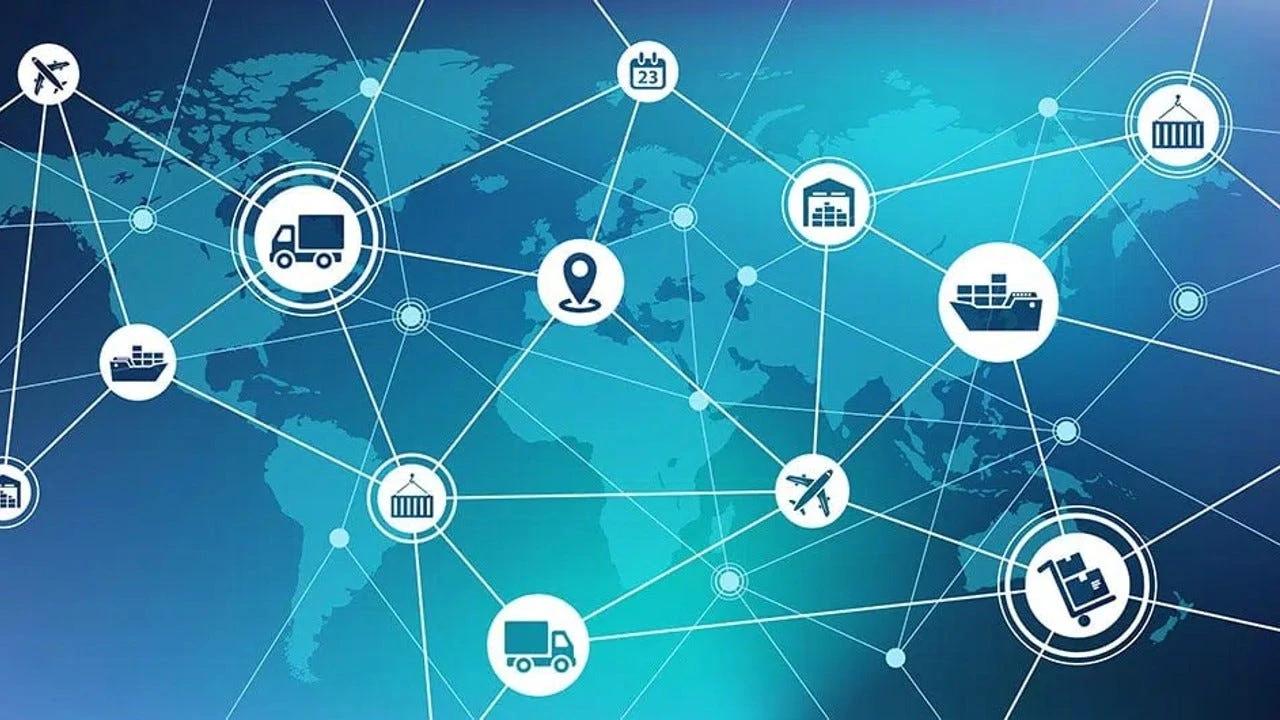
Let us look at an important angle that anyone talking about defense industries should consider: Supply Chains.
Defense manufacturing is not just about making weapons; it is the ability to ensure their continuous production, updating, and maintenance in an international environment where alliances and economic constraints are changing at an astonishing speed.
What makes defense economics complex is not the price of the weapon but its cost over its lifetime, a concept known in the industry as Life-Cycle Costing.
For instance, when you manufacture an aircraft or armored vehicle, you will find that only about 30% of the cost is the production price, while the rest is all operation, spare parts, upgrades, technical support, and logistics. This equation makes the industrial supplier more important than the base manufacturer itself.
The lessons learned from the Ukraine war have been tough but extremely important. Russia has thousands of tanks and factories, but when it entered the war, it found itself dependent on foreign electronic components in its guidance and communication systems.
Sanctions led to the effective disappearance of suppliers from the system, causing old technologies to dominate production lines, and the cost of local alternatives skyrocketed. The reason is simple: the sudden demand allowed local suppliers to monopolize the market, giving them the right to raise prices and extend delivery times after the foreign competitor vanished.
Economically, this is not just a sanctions crisis but a Supply Chain Management Disaster.
Europe faced the same problem when it discovered that the European assembly line for any advanced ammunition could be delayed by months due to a small supplier in Austria or Poland unable to ramp up production.
That is why the European Union is talking today about a new concept called Defense Value Chain Sovereignty, meaning that national security lies not in the number of aircraft but in your ability to control the components that produce them.
Herein lies the difference between industrial autonomy and operational autonomy.
You may fly your own aircraft and have full control over them, but if every electronic chip in it comes from abroad, or if any supplier could stop due to a crisis, your defense industry becomes economically precarious.
Turkey understood this logic early on. Since about 2015, it began implementing a plan called End-to-End Domestic Supply Chains, ensuring that every defense project has a real local percentage of components, especially sensitive ones.
For example, the project for drone engines was delayed for years because they did not want to rely entirely on foreign suppliers. They halted the project over a specific component they could easily purchase, but they preferred to wait for the local company to finish producing it before continuing.
Today, the Turkish defense industry has become a network of more than 3,500 companies distributed across sub-chains in electronics, mechanics, and software, all under the supervision and funding of the state and the Defense Industries Agency (SSB).
This type of economy is known in industrial economic literature as Economy of Scope. Let’s focus here a bit: this concept means utilizing the same manufacturing capacity to produce more than one product.
The Turkish supplier that manufactures aircraft parts is the same one that produces components for drones and naval missiles. This creates an industrial mass that is flexible enough to withstand any crisis or change in priorities.
On the other hand, countries that have defense factories but lack independent local suppliers or private companies are not building an economic system but merely a production facility. They manufacture weapons but do not establish a true defense economy.
This is the essential difference that enabled France, for example, to cope with supply disruptions after the Ukraine crisis, as it has an integrated supplier network. In contrast, Eastern European countries have fallen into the trap of complete reliance on abroad and are now trying to get out of it, but such matters take time and significant funding.
What makes the supplier more important than the weapon is that the supplier represents industrial memory. Weapons change every ten years, for example, but the factory or supplier that designed it is the one that develops the new version with its accumulated expertise.
If the supplier does not learn anything new or does not make a profit from their work, they will exit the system, and the accumulated knowledge will die with them. Economically, this is known as capability decay, which is the deterioration of skills and efficiency over time due to the absence of demand or administrative constraints.
Therefore, any country wishing to build a real defense economy must ask fundamental questions: Who supplies me the components? How do they supply them? What do they learn from this work? Do they export? Do they make a profit?
Because the supplier who exports and profits is the one capable of investing, training engineers, and developing himself. This is the decisive factor in the battle for modern defense industries: it is not the quality of the weapon that matters, but the sustainability of the chain that preserves and develops it.
This is an AI-generated English translation. The original text is in العربية
PhD Researcher in Defense Contracting and Cooperation Policies